Singlet Astronomical Observation Journal 1 March
Astronomical Observation Journal
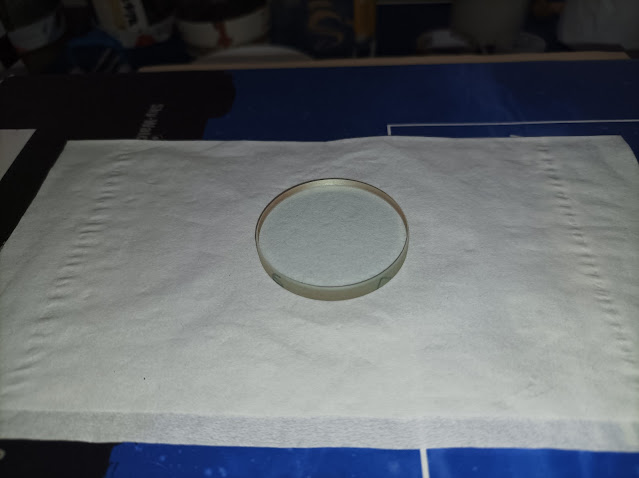
1 March – Campani Replica Singlet Objective (40 mm, 2440 mm)
Instrument Description
On the evening of March 1, I conducted a new observational session using an authentic Campani-type replica objective of 40 mm diameter and 2440 mm focal length. This lens is one of the finest Campani replicas I produced during the second series of singlet objectives last year. The remainder of that series has since been sold; this is the only specimen retained for personal observational use.
The instrument represents a long-focus, single-element refractor typical of late 17th-century optical practice.
Eyepieces Employed:
Plössl eyepieces: 25 mm, 20 mm, 17 mm
Positive Keplerian eyepieces (plano-convex): 25 mm, 20 mm, 14 mm
Principal Targets
The Moon
Jupiter
Selected double stars
Bright first-magnitude stars
I. Observations of Jupiter
This 40 mm × 2440 mm objective is currently the longest focal length singlet I have successfully produced using paper polishing. (The earlier 3.2 m, 47 mm paper-polished objectives were all sold.)
Keplerian Eyepiece – 20 mm
Magnification: 122x
Effective aperture: 40 mm
Jupiter presents a remarkably clear and aesthetically refined image. At 122x, the magnification appears close to the practical resolution limit for a 40 mm aperture under prevailing seeing conditions.
The equatorial cloud belts are clearly visible and well defined. The planetary disc is sharp and well defined with atmospheric structure visible has the main cloud bands visible at first glance. Contrast is moderate but sufficient enough not to decrease the fine details of the planet features, like cloud bands and other fine details between the belts.
When increasing the effective aperture to 42 mm by removing the diaphragm, the image becomes slightly more diffuse and chromatic aberration becomes more pronounced. A dark yellow filter (#15) can reduce this effect effectively; however, in the interest of historical authenticity since such filters were not available in the 17th century. I conduct observations at the nominal working aperture.
It is noteworthy that at 40 mm and 2440 mm focal length, chromatic aberration is only marginally greater than that observed in green float glass singlets. The difference is extremely slight.
The objective contains a visible longitudinal striation in the glass, detectable when observing bright stars at prime focus without an eyepiece in the port ocular tube without an eyepiece. However, this imperfection does not produce any measurable degradation of the formed image.

The Great Red Spot
The Great Red Spot is difficult to detect and may easily escape notice during casual observation. However, after 10–15 minutes of concentrated visual examination at the eyepiece, a subtle prominence from the southern equatorial belt becomes perceptible.
Since the telescope produces an inverted image (no diagonal or prism is employed), this feature appears visually in the northern belt in the eyepiece field. I do not use star diagonals or prisms except during public star parties for portability reasons; all serious optical evaluation is conducted in straight-through configuration.
II. Double Star Observations
Castor (Alpha Geminorum)
At 40 mm aperture and 122x (20 mm Keplerian eyepiece), Castor is a stunning sight. The pair is cleanly resolved, and this magnification is entirely sufficient for observing this celebrated double star.
The diffraction aesthetics of singlet objectives are, in my experience, exceptionally pleasing. I may state that even in achromatic refractors I have rarely encountered diffraction patterns of such visual elegance. Many observers are unaware of this characteristic; yet these instruments are remarkably well suited for the observation of bright double stars.
If 17th-century observers had systematically pursued double star surveys, they could have cataloged numerous with such instruments. Indeed, relatively few double-star observations are recorded in early Paris Observatory journals employing singlet refractors.
Gamma Andromedae (Almach)
This system was particularly impressive at 40 mm aperture, using the same eyepiece a Kepler 20mm ( 122x). The smaller companion appears as a distinct, round Airy disc adjacent to the primary. The separation is clearly distinguishable, and the pair presents a visually satisfying contrast.
Lambda Orionis
This double star also shows good separation between components at 40 mm. The Airy discs are somewhat soft in coloration but clearly defined, quite les bright so i need to employ the 25mm Kepler eyepiece for this double.
III. Bright Star Diffraction Patterns
Bright stars such as Rigel, Procyon, and Betelgeuse were examined at 122x using the 20 mm Keplerian eyepiece. When positioned at the center of the field:
The Airy discs are aesthetically pleasing.
The central disc appears slightly yellowish.
The first diffraction ring is visible and distinctly red in color.
The diffraction structure is comparable to that observed in pitch-polished objectives.
However, there is a subtle difference:
In pitch-polished lenses, the Airy disc and diffraction rings appear marginally more stable and geometrically linear. In the present paper-polished objective, the first diffraction ring occasionally appears slightly jagged or irregular, likely due to atmospheric seeing and minor surface micro-texture.
Improved seeing conditions would likely yield even cleaner diffraction structure.
IV. Comparative Optical Assessment: Paper vs Pitch Polishing
Based on observations conducted last year and continued this year:
Diffraction images produced by paper-polished lenses approach closely those produced by pitch-polished lenses. The overall difference in diffraction stability and sharpness is small.
In direct comparison, pitch-polished objectives exhibit approximately 3% greater stability and sharpness in diffraction features. This difference is subtle but detectable in steady atmospheric conditions.
V. Lunar Observations
Although not described in quantitative detail in this session, the Moon presents exceptionally refined structure at 40 mm aperture. The long focal ratio contributes to excellent spherical correction, and the restricted aperture moderates chromatic aberration sufficiently for highly pleasing visual results.
VI. General Conclusions
The 40 mm / 2440 mm singlet performs optimally at approximately 100–122x.
Aperture increases beyond 40 mm noticeably increase chromatic aberration.
Diffraction aesthetics in long-focus singlets are exceptionally pleasing, particularly for bright stars and double systems.
Paper polishing yields performance very close to traditional pitch polishing.
Pitch polishing remains marginally superior in diffraction stability and ring definition.
Historically, such instruments were entirely capable of meaningful double-star observation programs.
This session further reinforces the optical validity of long-focus 17th-century refractors when properly executed and correctly stopped down deliver good images of planets the Moon and double stars.


Comentarii
Trimiteți un comentariu