Detailed Singlet Astronomical Observation Journal
Replica Campani Refractor – Willach Collection
Instrument: Campani-type singlet refractor (replica, Willach Collection)
Full objective diameter: 47 mm
Effective aperture employed: 29.5 mm (comparative test at 35 mm)
Focal length: 1850 mm
Optical configuration: Single-element objective symmetric biconvex lens (singlet), Keplerian eyepieces (plano-convex)
Observing Conditions: very good
The observations were conducted under stable atmospheric conditions with satisfactory transparency. Seeing was sufficiently steady to permit reliable evaluation of diffraction patterns and planetary detail at moderate magnifications.
I. Observations of Jupiter
Eyepiece: Keplerian plano-convex, 25 mm focal length
Magnification: 74X
Effective aperture: 29.5 mm
Jupiter was selected as the primary object of observation.
At 74X, the equatorial cloud belts were easily visible. The planetary disc was well defined and stable. Chromatic aberration, inherent to a long-focus singlet objective, manifested as a faint diffuse halo surrounding the planet; however, at this restricted aperture it remained modest and did not significantly degrade the image.
The overall impression at 29.5 mm was that of a reasonably sharp and well-balanced image for an instrument of this type and aperture.
Aperture Test at 35 mm
A diaphragm increasing the effective aperture to 35 mm was then installed.
The immediate effect was increased image brightness and slightly improved theoretical resolving power. However, chromatic aberration became noticeably more pronounced. The blue fringing around Jupiter intensified, reducing perceived sharpness and contrast.
Visually, I preferred the image at 29–30 mm aperture, which corresponds closely to the original diaphragm employed in historical Campani instrument. The reduced aperture clearly provides a superior balance between resolution and chromatic control.
This practical result strongly supports the historical choice of aperture limitation in 17th-century long-focus refractors.
 |
| The 1850mm refractor on the Eq1 mount in the autumn of 2025 |
II. Stellar Diffraction Patterns
Bright stars such as Rigel and Sirius were examined to assess optical figure quality. At 29.5 mm aperture: 132x Kepler eyepiece 14mm. The Airy disc appeared large and aesthetically well formed. A thick outer diffraction ring with a reddish tint was clearly visible. The diffraction pattern was clean and symmetrical. The diffraction images were comparable in quality to those obtained with lenses polished on pitch, indicating that the optical figure of this objective is well controlled at the used aperture.
III. Double Star Observation – Castor
Eyepiece: Kepler 25 mm
Magnification: 74×
Aperture: 29 mm
Castor was clearly resolved. The two components appeared as a well-defined figure resembling the number “8.” The Airy discs were round and visually pleasing.
Eyepiece: Kepler 14 mm
Magnification: 132×
Aperture: 29 mm
At higher magnification, the separation became more critical. The primary star exhibited a large and bright Airy disc. The secondary component appeared nearly tangent to the primary.
With careful and concentrated observation, a thin black gap—no wider than a hairline—could be perceived between the two stars. The resolution at this aperture and magnification is near the theoretical limit, yet clearly attainable under steady seeing.
IV. Jupiter at Higher Magnifications
Eyepiece: Kepler 20 mm
Magnification: 92x
Aperture: 29.5 mm
At 92×, Jupiter appeared larger in apparent diameter. The equatorial belts were significantly clearer than at 74x, and the separation between equatorial and polar regions was more distinct. This magnification appears particularly well suited to the combination of 1850 mm focal length and 29–30 mm aperture. The optical system seems optimally balanced at this configuration. At 35 mm aperture, although diffraction-limited resolution is theoretically improved, chromatic aberration becomes dominant and diminishes perceived clarity.
The 29 mm setting delivers a noticeably sharper and more aesthetically coherent image. This practical experience clarifies why Campani selected approximately 29 mm as the working aperture in his original instruments.
Eyepiece: Kepler 14 mm
Magnification: 132×
Aperture: 29 mm
At 132x, Jupiter remained well defined. The equatorial cloud belts were clearly visible. The polar regions were distinguishable, separated by lighter zones. Global contrast was moderate. Chromatic aberration appeared as a faint surrounding haze. The image was somewhat dim at this aperture and magnification combination, yet remained sharp. Contrast suffers slightly at this power, but the principal atmospheric structures remain observable.
V. Lunar Observations
The Moon was exceptionally pleasing at 29–30 mm aperture.
Kepler 20 mm (92×), extremely sharp image, little chromatic aberration, sharp details at crater rims, the limb of the moon has a little chromatic aberration almost like a line.
Excellent terminator contrast. Crater rims and shadow boundaries were well defined, dark background filed of view.
Kepler 14 mm (132×)
Image remained sharp.
Slight decrease in brightness, fine structural relief remained visible. The restricted aperture effectively moderates chromatic aberration while preserving sufficient resolution for detailed lunar observation.
VI. Optical and Historical Conclusions
An effective aperture of approximately 29 mm is optimal for this 1850 mm singlet objective.
Increasing aperture to 35 mm enhances brightness but significantly increases chromatic aberration.
Diffraction patterns at 29 mm are clean and symmetrical.
Planetary performance is best at magnifications between 74x and 92x.
Double star resolution approaches the theoretical limit at 132× under stable seeing.
The historical use of aperture stops in Campani refractors is empirically justified.
These observations demonstrate that 17th-century optical practice specifically the deliberate limitation of aperture was not merely a technological constraint, but a rational optical optimization strategy for long-focus singlet systems.
Here is a video through the 29mm refractor with my smartphone at the 20mm Kepler eyepiece:
The original Campani telescope:
.jpg) |
| Campani original lens in Willach collection source dioptrice 1775 |
.jpg) |
| Campani original lens in Willach collection source dioptrice 1775 |
 |
| Campani original lens in Willach collection source dioptrice 1775 |
 |
| Figure 9. Objective lens of a c. 1665 telescope by Giuseppe Campani in the Willach Collection. Photo |
 |
| Figure 9. Objective lens of a c. 1665 telescope by Giuseppe Campani in the Willach Collection. Photo |
 |
| Interferometric tests and PSF of the original Campani lens done by Tiemen Cocquyt |
 |
 |
| Campani original lens tested by Willach source dioptrice 1775 |
 |
| The optical tube |
 |
| Objective lens cell |
 |
| Eyepiece housing |
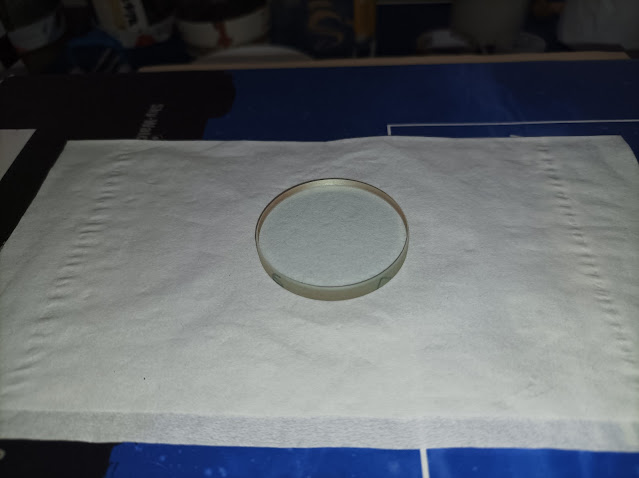
My replica lens:


Ronchi tests single pass full diameter


Comentarii
Trimiteți un comentariu